Ellie Siegel (She/Her)
(In non-striped shirt, striped shirt Will Ryan, writing professor at Hampshire)
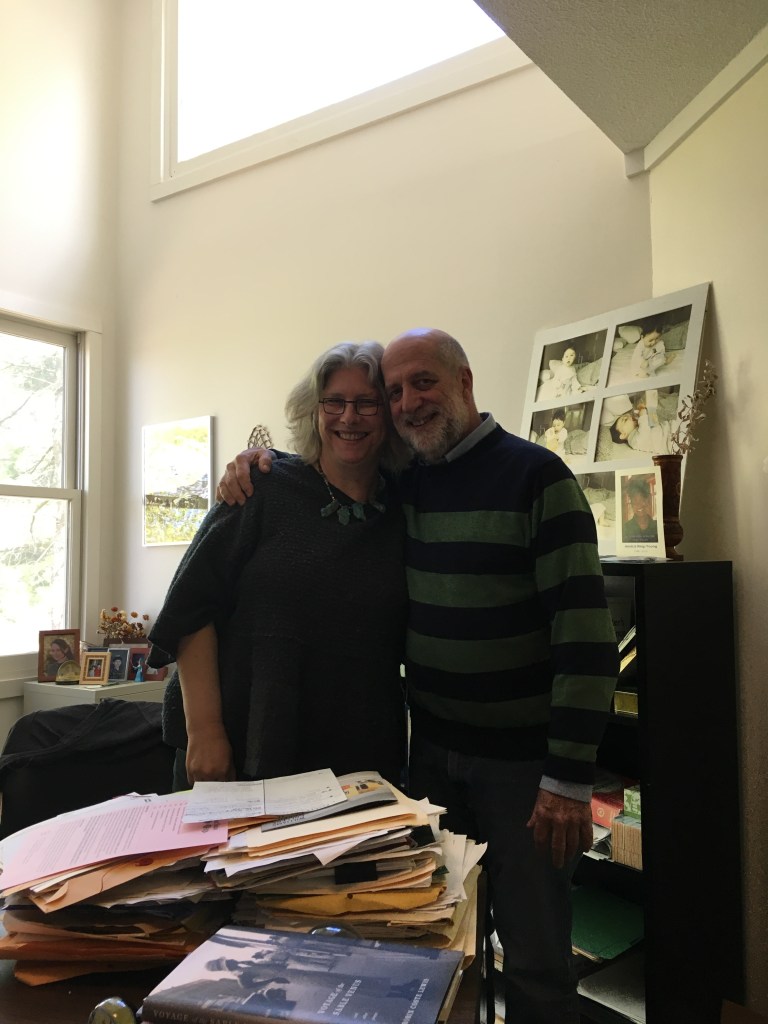
Self-Bio: After graduating from Hampshire, Ellie Siegel worked at a video documentary center and in radio and print journalism, co-organized a British Feminist Writing Conference, published short fiction, was fiction editor at a feminist newspaper, taught poetry at the University of Minnesota, and completed a M.F.A. at Sarah Lawrence College. She spent the next 32 years teaching writing at Hampshire.
Year of div 3: 1977
Name of div: Writing
summary of your div 3: A portfolio of experimental and narrative creative writing.
Hampshire’s influence: During my student time at Hampshire I began to ask many of the questions that have propelled my life.
What place on campus was significant to you? Why is it significant?: I’m tempted to say “inside my mind,” as I spent a lot of time in my own head. But here’s a place on campus: a curved path leading from EDH to the library, near what is now the Writing Center, where after class one day I sensed a powerful connection with a friend who I knew I wanted in my life.
Describe the on-campus place as you remember it. : The path isn’t very long, maybe 40 feet, and curves gently through a small grove of deciduous trees. It’s late autumn, with slanted light filtering through the branches and the musky scent of rotting leaves.
What place off-campus was significant to you? Why was it significant: My family’s cabin on the western shore of Roger Lake, Emily, Minnesota, is the soul’s home for everyone in my family. It fed me from afar the whole time I was at Hampshire, and I lived there with my dog during the summer I was writing my Div III.
Describe the off-campus place as you remember it.: In the woods, on a lake, thick summer greens, bright days, dazzling stars, and clattering thunderstorms at night. A three-room log cabin with a porch and an outhouse. Thick dark logs with crumbling white mortar. Noisy nature: rain drumming on the roof, mosquitoes whining, and mice, chipmunks, and squirrels scurrying along with the kitchen counters and bolting through the bedroom.
3/1/21
Dear you,
If I am writing you in the fall of 1972, you are in your cinderblock dorm room in Merrill. It is your first semester at Hampshire College, the only college you applied to, the college where you thought you’d find your people, whoever they turned out to be, and your work, whatever that turned out to be.
Your dad and your sister drove you from Minneapolis to Amherst and helped haul your clothes, record player, and boxes and boxes of records up to the 4th floor. As you unpacked, your father leafed through the black and white photos in the Hampshire Frog Book, with names and hometowns of the student body, pointing out the pictures of all four students who came from Yellow Springs Ohio, the town where both he and your mother went to college, met their people—including each other—and set them on a path to their work.
You like your bedroom. You especially like listening to your music in your bedroom, the Mothers of Invention, the Everly Brothers, the Kinks, Hank Williams, Philip Glass, the Beach Boys. You’re surprised that you’re not particularly drawn to any of the other people on your floor; your favorites are probably the drunk Grateful Dead fan/premed student passed out on the floor outside her door and the straight male painter who likes wearing feather boas, although you spend the most time with the nice, utterly grounded woman who wants to be an elementary school teacher. A Long Island woman down the hall has introduced you to All My Children, a soap opera that you watch together on the TV in the lounge. You’ve never watched a soap opera before.
You feel most on fire about the parts of your life that are happening elsewhere. In rural Minnesota, in New York City. You spend a lot of time writing letters to people who are not at Hampshire.
Your classes are kind of boring. You want to feel electrified, and that’s not happening. This is not an unusual experience for you. You were always a big reader, but except for Latin, which felt like the keys to a kingdom of understanding the creation of the English language, and your 9th grade world history class, which really did explain something about how the world developed, school was mostly a series of jobs for which others rewarded you for doing well. For your last two years of high school you attended academic classes only in the mornings and then, after lunch, you happily escaped to theater and dance classes in other locations around the city.
Your best day at Hampshire that fall is when you hitchhike to Wellesley College to film an Acme Dance Company performance. The next morning you and your Wellesley friend hitchhike to the beach at Swampscott to watch the sun rise. It’s late October but you’re Minnesotans, and you strip off your jeans and wade in as far as you dare, Midwestern girls thrilled to have the vast, noisy ocean so available, almost just down the street from your schools. Somehow you two make your way back to Boston—there may have been a subway ride, also exotic–and eat a dim sum breakfast in Boston’s Chinatown, where an old woman dances to the “Candy Man” song playing on the juke box. You love your Wellesley friend for her fire and hunger for life. You’re looking for something like that in people at Hampshire, but they seem strangely sleepy. Maybe you look sleepy to them, too.
At Hampshire your least favorite class is in Language & Communications—later it would be called Cognitive Science—but your favorite class project is for the same course. You and a male research partner stand by the manorial frat house at the corner of Routes 9 and 116, thumbs out, logging whether making eye contact with the oncoming drivers increases your chances of scoring a ride. It doesn’t. Being a single woman does. But obviously, you already knew that.
Your questions: Where are my people? What is my work? Where is the electricity?
If I am writing to you in the fall of 1973, your second year of college, you are in your bedroom in Mod 26, House Three, later called Greenwich. In order to get control over your housing and mod mates, you signed up as part of an Artists Mod identity-based housing. You and the boa-wearing artist organized the group last spring while you were assistant directing his production of Boys in the Band. The play went well, and you found it moving, but this is not your kind of theater: it is the kind of theater where the play’s production could be superb or shoddy, but in either case will follow a trajectory that is obvious from just reading the script. You are on a hunt for theater and performance that is more experimental and open-ended in impetus, where the life in live theater is palpable, where the stakes feel electrifying.
You are having some interesting conversations with the other artists in your mod, who include painters, musicians, and a filmmaker. You’ve never realized before how making things and doing creative work involves asking similar questions and attending to similar concerns, no matter the medium. What is the relationship between form and content? How do you build a practice while leaving yourself open to experimentation? What is a cliché and how do you avoid them?
You also have made a real friend, a poet and dancer who grew up in New Jersey, whose family convinced her that she was really from rural Missouri. You love that she’s smart, soulful, kind, curious, and urban/rural bicultural.
By now you’ve switched advisors twice and have landed with a gentle, thoughtful man, David Smith, who everyone says is great at helping students make sense of Hampshire. When you approached him to be your advisor he originally turned you down, saying that he was way too over committed, but he relented when you started sobbing. You’ve also taken two classes that interest you. Last spring in Dr. Gloria Joseph’s “Cultural Lifestyles of Minorities as a Factor in School Performance,” you generated a thought you hadn’t had before: that the Protestant work ethic was a cultural construction. (But you didn’t have the language to call it a cultural construction.) And you really enjoy both the reading and writing for your Literary Journalism class.
You feel intensely burdened by and guilty about the fact that three semesters in, you have completed zero of your four Division One exams, independent projects that are the only academic milestones that matter at Hampshire—attending and finishing classes count for nothing.
Before you began college, your parents had told you that they would pay for 4 semesters at a private school, and the rest was up to you. There was no plan, and you didn’t really understand how they imagined this working out, but since Hampshire’s system involved so much independent study anyway, you figured that somehow it would. At this point, however, although your advisor David Smith doesn’t seem worried, you are aware that you have already burned through ¾ of those four semesters. It is increasingly difficult to see how this will end well.
Meanwhile, other really interesting things have happened:
Over January and continuing into last spring you had an internship with the Acme Dance Company in Manhattan, during which time you were housed by a Harvard Law grad who both managed and danced with the company. He taught you a ton, both about watching dance and also about the smoke and mirrors survival strategies of financially fragile arts organizations.
Your most electrifying reading was about director Andre Gregory’s Manhattan Project theater company, which Doon Arbus chronicled in a book titled Alice in Wonderland, the Forming of a Company and the Making of a Play, augmented by startling photographs by Richard Avedon. In high school you’d been deeply moved by Richard Avedon’s photography and by the Manhattan Project’s theater work, and here they were together. Although this reading was relevant to your study of improvisational theater for your Humanities and Arts Div One exam, you would have read this book anyway; hence it seemed to you that Hampshire had nothing to do with this.
While reading and rereading this book, somehow you became aware, in this pre-internet age, that over the summer the Manhattan Project would offer an intensive theater course at NYU, all day, five days a week, for six weeks. I don’t remember how you convinced your parents to pay tuition for this—maybe you borrowed the money? The Grateful Dead fan from your first-year dorm hall offered that you could stay for free at her grandmother’s Brooklyn apartment for part of the summer session, and the Acme Dance Company dancer/lawyer let you stay at his place for the rest of it.
Everything about the NYU class was fascinating and exhilarating. After the mornings of physical exercises, there were hours and hours of improvisational scene study, developing an approach to scripts that was unpredictable and authentic, calling for an intense awareness and openness, and the ability to respond moment by moment to where the energy of both you and your scene mates was most alive. You loved watching Andre Gregory’s face as he leaned towards the work, watching and listening for life.
Now, back at Hampshire following that summer session, you have undergone a flattening—and also instructional—experience in your current theater class. For scene study, you built on your Manhattan Project studies, presenting work that was intense, whacky, and both motivated by the script and arguing against its received conventions. In their critique, working bit by bit to adjust the exterior details, the class comments advised that you dismantle and deaden every moment, until the scene followed the predictable trajectory they expected it to have before your work began.
This is a profound turning point for two reasons: First, it is clear that this class will not help you explore work that matters to you. Second, you realize that given that theater is a collective art, continuing in theater means repeatedly confronting this challenge: Just to create the work, you will always have to convince other people to share your universe.
Your questions: If creative work across different media shares similar concerns, should you switch from theater to writing, which doesn’t involve convincing others to come with you? What might it mean to make art that is truly alive through writing?
If I am writing to you in the fall of 1974, you are living in your parents’ basement, your old bedroom having been taken over by your sister even as you were packing for college. You share the basement room with a terrarium of your mother’s pet snakes. You feed them live frogs, then lie in bed watching the snakes stalk and eat them, the lump of frog traveling inside the body just like the elephant in the Little Prince illustrations. There is always a faint odor of rotting meat wafting from the snake cage.
You’ve been home for two semesters now, since it made no sense to squander that last semester of tuition when you could work independently on the Div I exams for free. Your advisor, David Smith, said to keep track of everything you are doing, because it can all go into your Division Two.
At this point your life now feels like it is running three very different stories.
Story one, the one that feels most real: You are an utter failure, having dropped out of college with no academic progress having been made. You are happiest when you are making trips to northern Minnesota to hang out with two friends, guys living in a converted gas station, or when you are watching children’s television programs with your twelve-year-old brother.
Story two, which, while factually true, feels like a lie or a cover story: You have a paid job at the local museum, assisting the director of performing arts programming, and you spend as much time as possible watching performances and taking part in visiting artists’ residencies. A second paid job doing market research phone calls is a surreal journey through the subliminal effectiveness of advertising. You take lots of dance classes and eventually sign on for a full load at the University of Minnesota, mostly boring except for a revelatory upper level/graduate geography class that led you towards exploring the connections between the natural environment, the built environment, history, and society.
Although you barely remember doing it, you also wrote and passed three Division One exams: a Humanities and Arts paper on avant garde theater, a Language and Communications literary journalism piece inspired by the guys in the gas station, and a Social Science paper on rural Minnesota, contextualizing the literary journalism.
Story three, which you don’t yet know how to think about: Remember that Wellesley friend, from your first year, who was full of fire and hunger for life? She, too, has dropped out of college, and is back at her parents’ house, only instead of watching tv with her younger siblings, she plays hours of card games with them. Although neither of you has language for it, the two of you recognize something in each other that hinges together, along with what you are seeing in other girls—the middle school girls in the summer camp where you are a counselor, as well as your old high school friends: one who lives with and supports her rock musician boyfriend, one who is becoming an alcoholic, two who have developed terrifying eating disorders, and one whose embrace of her lesbian joy feels to her like sheer terror.
Your questions: Will I ever leave my parents’ basement? Will I ever want to?
If I am writing to you in the fall of 1975, you are back at Hampshire, living in a Greenwich mod, finishing your Div II. Huh?!!? You definitely did not see that coming. But remember that kindly advisor, David Smith? He seemed to think this was perfectly normal.
I’ll catch you up on more details, but I want to cut to the chase on a second item that you didn’t see coming: you are beginning to think of yourself as a feminist artist.
You already had progressive politics, of course—you grew up in a liberal family during the Sixties. You were against racism and U.S. involvement in the Vietnam War, and for socialism. You were certainly not anti-feminist; women should be able to do anything men did. But you believed that politics were irrelevant to and even destructive of art. You believed in pure creativity, floating in some realm that was simply human. To invite politics into art meant flattening the life force into received narratives.
Even more unexpected: Despite the fact that only rarely did anything important happen to you through academic coursework, your relationship to feminism and the arts has developed through a class and conversations with its professor, Jill Lewis, who is now on your Div II. Jill understands both the artistic avant garde and politics, and with her you are starting to thread those two conversations into one dynamic exchange, each realm informing and expanding the other.
You hadn’t intended to take Jill’s class on women and literature. You’d already taken a course like that at the University of Minnesota, and it was pretty deadly. But David Smith urged you to try it out, saying that he thought Jill would be great for you. And right out of the gate, the class discussions of Virginia Woolf turn you upside down and inside out. You love seeing how Woolf’s handling of time echoes some of what had intrigued you in performance experimentation, while also giving space to a feminist critique. More importantly, Jill also interrogates your reliance on a vision of art as somehow pure, that we can create something true without questioning the structures that shape our human experience and consciousness. You were already interested in how history, class, and place shape us, but that terrain had existed separate from art, which for you retained a purity, as opposed to didacticism or agitprop. Suddenly you see that neither art nor “humanness” nor consciousness can be understood and enacted separate from politics and social constructions—and further, that artistic practice—creative writing—could be an investigative tool. You are hooked.
You begin to read. Just as you had never noticed that there were barely any women in the boxes and boxes of records you’ve hauled around with you, you hadn’t noticed that virtually all of your books were by men. Now you are reading the hilarious, dense, narratively upending short stories by Grace Paley, Gertrude Stein’s narrative-shattering experiments as well as her funny and accessible Autobiography of Alice B. Toklas, Adrienne Rich’s searching feminist poetry, more Virginia Woolf, Nathalie Sarraute’s miniature stories, and Alice Walker’s article about Zora Neale Hurston.
You revisit the book that electrified you in your first year at Hampshire, the story of how Andre Gregory’s Manhattan Project conceived of and produced their work, and as you read, you replay the scene study you did with them that summer at NYU, this time, framing their work and relations through a feminist lens. And similarly, you are now listening to stories from your friends and family with changed ears, alert to the counter narratives, the unspoken, the way that different questions and different framings shifts how we understand our world.
Two other important things are happening:
You are seeing a therapist in Boston, which involves hitchhiking to Boston and trading work in his office for therapy sessions. He encourages you to start meditating and reading about Zen Buddhism. You see this as another method for being fully present as part of your creative practice.
And there is a guy. He’s got a girlfriend, so he has not expressed any interest in a relationship with you, but you are doing your best to lasso him into your life, although you’re not sure what that means, as theoretically, as a feminist, you like the idea of non-monogamy. He’s in your writing class—and likes your writing √, he grew up in a small, racially diverse Midwestern town and understands that the world is not all white, urban and East Coast √, and he chose to spend a junior year abroad in Minneapolis, which he loved √. After your writing class you try to time your walks across campus from Emily Dickinson Hall to the library with his, and you love talking with him. He’s smart, a great listener, and he’s curious about everything. And his is one of the four Yellow Springs, Ohio, photos your father excitedly pointed out to you four years ago when he moved you into your first dorm room.
Your questions, about the avant garde, feminism, and artistic practice, are now becoming your Div III.
If I am writing to you in the fall of 1976, your final semester of college, you are living in a Northampton apartment with two friends, a dancer and that New Jersey Missourian you met in your first year. She is also in your Division Three seminar, an independent study on women and writing.
Your Div III is about developing a meditative writing practice, exploring consciousness through automatic writing, writing as a feminist, playing with language as a jumping off point into surprising, unexplored terrain, and using writing to understand what you don’t have words for. During your first Div III semester, while living alone in Boston and taking dance classes, you focused on language experiments, which you enjoyed but eventually ran their course.
Last summer, living alone in your family’s cabin in the north woods, you continued to write, and there you began to pivot towards exploring how narrative and storytelling fit into your work. You find that it’s difficult to tell a vulnerable, alive, and open-ended story, and this challenge intrigues you.
Last summer you also noticed articles in the local Minnesota newspapers written by a journalist and critic who, like you, is engaged with both progressive politics and avant garde artistic practice. This is a rarity, so you sought out the writer, beginning seminal conversations with her that would continue for decades. That guy from your Hampshire writing class is also back in Minneapolis, now girlfriendless, so you invited him to see a feminist theater company’s play called RAPE. He’s up for that—he wants to know more about feminist theater √ You two fall into decades of daily conversations on art, politics, writing, feminism, and life.
As you move towards graduation, you don’t at all feel that you are anything resembling a finished product. But you do feel full of curiosity. You’re taking a class about contemporary China, a place that continues to radically and traumatically reinvent itself in search of social justice. You travel to New York to watch Robert Wilson and Phillip Glass’s mesmerizing new opera, Einstein on the Beach, which continues Wilson’s experiments with time and visual space in performance, but you also make a trip to hear Patti Smith, enthralled by her loud, fearless, original voice.
And, when you’re not writing (or reading primary research studies and hooking study subjects up to an EKG machine for your final Div I exam in Natural Science—asking whether trance music induces a trance state), you continue to read fiction written by women, guided by an annotated bibliography of women’s fiction assembled by women in Cambridge, Massachusetts. Since Cambridge bibliographic research hasn’t turned up very many books written by women throughout history, the entire list fits into one small, staple-bound volume. (Or had even that small volume even been published yet?)
Beyond that, you have no idea what in the world you’ll do next.
Your questions:
How can I sustain a writing practice—while earning money?
How can I expand my understanding of what the category woman means?
How can I use my work to better the world? How can I build scaffolding for my own work, as well as the work of other women?
What kind of work makes me happy?
What kind of life do I want to live? And how can I live it with the most open and attentive presence possible?
–Ellie Siegel
P. S.
What are you curious about? Why is this important to you?
Requiring students to discover their questions and fumble towards answering them means that many alums leave Hampshire with the impression that the college hasn’t done much at all to shape, let alone nurture, their intellectual and creative growth. Hampshire uses terms such as “self-designed majors” and “student-driven inquiry,” but seldom articulates how scary and difficult this kind of learning can be, with the results often invisible, both to the student and to the world.
Your own experience has been that you stumbled around, produced embryonic writing, and received a degree.
After undertaking that vaporous journey, with a few grades, no major, and Division Three work that feels utterly embryonic, you are left to self-authorize, both to the world, “I studied writing and current American culture” and more confusingly, to yourself. Since you sort of have a degree in writing and American studies, you think that maybe journalism is an area worth investigating, and the journalist/critic you had sought out the summer before you graduated helps you line up a paid internship with a Minnesota Public Radio that starts as soon as you have your degree. It is a relief to have another cover story, the acceptable outside version of an internal process that is very much still evolving.
What are you curious about? Why is this important to you?
It is only incrementally, over the decades, that you start to understand how formative Hampshire has been over your life journey. To carry throughout life the North Star of self-authorization fueled by curiosity and a passion for social justice is a profound gift. But the words and phrases that you and the college have generated over the decades still don’t quite capture the complexity and depth of the learning curve.
Eight years after graduating, invited by David Smith to apply for the job, you return to Hampshire to teach. In one of your early Div II meetings the student presents a raw, incoherent statement of interests to his committee, comprised of you and a senior faculty member, who immediately signs on. After the student leaves, the professor turns to you and comments, “We just handed him a fishing license.”
While you were still a student, someone coined the phrase, “creative floundering” to describe the loneliness and lostness you experienced, along with hinting at its generative power. Although Creative Floundering only partially described your own trajectory, the idea was helpful to you in that it hinted at a communal experience, something that others besides you were undergoing.
Nevertheless, probably because it was such a terrible marketing tool, by the time you returned to Hampshire to teach, the mention of “creative floundering” had been banned.
 What We Remember