Ellen Sturgis (She/her)
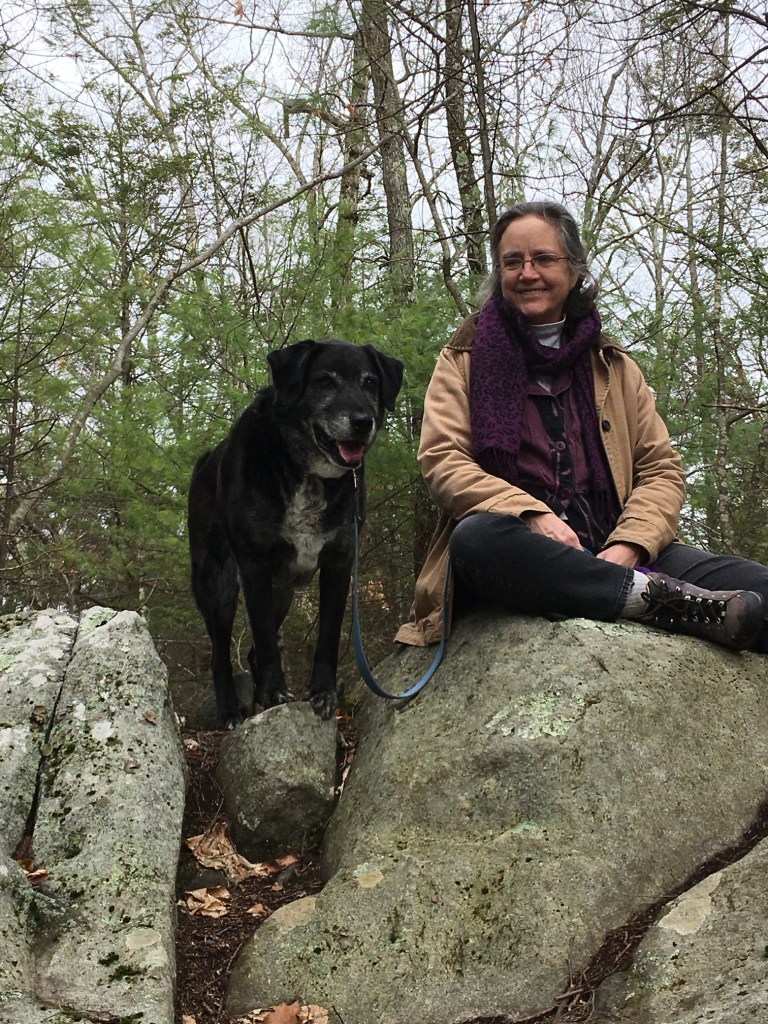
Self Bio: I’m 77F and have spent the last 35 years in nonprofit finance & administration. I was the first chair of the Alumni Advisory Group and now site on the Trustees. I’m currently on the Selectboard in my town and ran unsuccessfully for state rep in 2008.
Year of div 3: 1980
Name of div: A History of New England Town Meetings
Summary of your div 3: I started out wondering about town meeting as a vehicle of social change. But a deep dive into the history starting in the late 1600s showed that they came out of an autocratic church (puritans) that required participation but were far from democratic.
Hampshire influence: I’ve been heavily involved in Smalltown, Massachusetts politics for 30 years!
What place on campus was significant to you? : The donuts (3&4 I think) – that’s where Mixed Nuts was based and I was staff for 2 years (my closest Hamp friends were co-workers)
Describe the on-campus place as you remember it.: The store was in one of them — pretty limited coolers, on the upper center level— DONT remember much more. . We were a preorder then. The delivery came in. That night we (cheese managers) organized cheese cutting in the open center space. We cranked up the music and had a blast.
What place off-campus was significant to you?: Steeplejacks restaurant in Sunderland. One of my primary destinations during Div 3: we’d ride our bikes for breakfast. Daisys in Amherst was another breakfast destination.
Describe the off-campus place as you remember it.: Both just funky restaurants. Daisys was pretty small but catered more to the college students. Steeplejacks felt more “local”- big open space, the best pancakes and real maple syrup !
A letter to my younger self about the value of a liberal arts education
To my 1980 self, who would just be starting the Div III process,
You might not be aware of how much these first three years at Hampshire make perfect sense when looked at from here in 2020. Certainly seemed chaotic and unrelated at the time didn’t they?! I remember my first big “aha” moment was when it occurred to me, some five plus year after graduating (maybe at my first bi-decade reunion?) that Hampshire was still really new when I went there—I entered in 1977, only 7 years after the first class. They didn’t have their shit together at all! Advising was haphazard at best, the Div process was decided by those on your committee, there were a lot of students getting lost in the “cracks” (and 40+% that dropped out as a result). But what an awesome wonderful chaos it was!
Going back to my high school self, I remember how deeply I didn’t want to jump into college. I spent a lot of time researching programs to do for a year before launching into school (it wasn’t as commonly referred to as a gap year then). But the Weston HS guidance office and my parents were not to be convinced. And so I focused on colleges that were as “un-college” as I could find. The only thing my parents and I agreed upon was a liberal arts education was de-facto what I should seek out. Luckily, my mother worked at Beacon Press at the time which produced a (very thin) catalog called Guide to Alternative Colleges & Universities (I recently found and bought a copy on ebay). There were 3 colleges on my list: Evergreen State in Olympia Washington, Oberlin College in Ohio and Hampshire.
I REALLY wanted to get away from Massachusetts—I had spent the majority of my senior year in HS living away from my parents and I felt strongly the farther the better. Evergreen seemed perfect: opened in 1971, a STATE school (I was impressed that a State would support such a different type of education), and it was in Washington State (never been). But somewhere, “they” decided it wasn’t accredited and so therefore I shouldn’t go there. (I learned many years later from a good friend that in fact it was—accredited in 1974). In any case, that left 2 and I applied to both—I know with Hampshire I applied for deferred admission which they actively offered. I was accepted at Hampshire, rejected from Oberlin. So the decision made. But then the parents insisted I start that fall, and so reluctantly I requested and received admission for Fall 1977 (which has become my signature, my email and should be my magic number!).
It’s not like I knew anyone taking a year off—I just felt I wasn’t ready. The last year of high school was both emotionally challenging and I really didn’t want to be in school. I had always loved it, had a small but deeply valued group of friends—but I knew something was amiss and I was far more excited about possible internships than I was about college—but it was not to be. I also absolutely had no idea what I “wanted to be when I grew up”. I was not the kid who always wanted to be a doc or a vet. That clearly was why I could look at “non-college colleges” because I didn’t have to be constrained by their specialty! But then again, I don’t recall a lot of friends choosing colleges because of their curricula focus (maybe there was a pre-med in there somewhere but I don’t recall now, and one of my high school classmates who also went to Hampshire became a doc, so there!)
I got my head around Hampshire pretty quickly—only 80 miles from home which wasn’t great – when I went to visit for the first time (fall 1976), I thought it the most beautiful campus possible (the classic walk over the hill from the Red Barn on a crisp clear September day). During spring 1977, Hampshire became the first college in the country to see student sit-ins, demanding divestment from South Africa, and they had a nationally “ranked” Ultimate Frisbee team (came in second in the first national tournament). What wasn’t to like?! Was I thinking liberal arts at that point? Well for sure, I was done with grades and just wanted to learn, so yes, it was there, though honestly not front and center.
But do you remember arriving in September 1977?
As classes started, my advisor, who also served as Dean of Students, was nowhere to be found, so I chose what I liked with absolutely no plan. As mentioned, Hampshire had no idea what advising should look like at that point and I would guess most of my classmates worked without one for at least their first year. I think I started with five classes, but one by one, they dropped off. But I was super lucky that one of the few classes that remained was a literature course called Coming of Age, team taught by Sally something, John Boettiger and David Smith. The icon of Hampshire humanities! The books they brought to us were, as I look back, awesomely significant and all new to me. Rita Mae Brown (Rubyfruit Jungle) and Margaret Atwood (Surfacing: it was only her second novel). I can’t remember other titles just now, but it was what I came to describe as a quintessential Hampshire class. Conversations were thoughtful, the professors were amazing, we went several times to David Smith’s home for dinner, music and more conversation. That semester I also took an anthropology class with Len Glick – again at the time, I didn’t know how those classes would resonate through the years, but it’s one I remember more than many. I’m not sure I finished any other classes that first semester. But thanks to David Smith, I completed my first Div I. I became a volunteer at a local nursing home and met Sadie, who had grown up in a town that no longer existed due to the creation of the Quabbin Reservoir. She was in her late 80s, but sharp as a tack, shocking all white hair, a great humor. So I spent hours listening to her stories and wrote my Div I as an oral history of Sadie, her memories, poetry about the impact she had on me, and lessons learned about the Quabbin (having grown up in eastern Mass, I was horrified to learn no one had ever mentioned this story). In some ways, that was really the dawn of my liberal arts education. And through classes and especially because of dorm living, I developed an amazing group of friends, many of whom have stayed in my life 40 years later: could you imagine that? I remember some deep thoughtful conversations, one particular on the roof of Dakin which both broke my heart and took me deep into reflection. I got a job at the post office and found a wonderful community there. I sang briefly in chorus—not a fan of the infamous director but found great friends.
In spite of these two classes and one Div I complete, I was still unsettled and wrote a letter home (phone calls were rare and email non existent) to explain to my parents why I intended to take the next semester off. I recall I said I still felt like I wasn’t sure what I was doing in college and I was “wasting their money”. The surprising response was that my dad, who had said little about my choice that I recall, and who hadn’t joined my mom in driving me out to Amherst initially, called to say he was coming out that next weekend. This became a seminal moment in my education as it turned out. Sometime during the course of this visit, my dad told me “his plan”: I should come back to Weston for the semester, take classes at Boston State and apply to Harvard, which was, to his mind, where I should be. (For perspective, most of the men on both sides of my family had gone to Harvard, yet not one of my siblings had even applied). Clearly I was the last chance to “continue” the tradition, even though Harvard was absolutely NOT the right place for me! What made this a critical interaction was what Dad described next, which he believed not available at Hampshire. “You’re missing what’s critical to a liberal arts education”: he noted that I need to try ALL the different disciplines, while I had allowed myself to be very narrow. In retrospect, Dad was the advisor I didn’t have—ironic given our relationship had never been based on good communication! (note to Molly: this is why your proposed assignment caught my eye!) But it did the trick to some extent. I didn’t follow his plan, but I did look at the next semester course offerings with a lot more thought: I took a science class, economics, Shakespeare at Smith, history at Hampshire. By the end of the semester, I was developing a vision of my Div II and thoroughly and deeply in love with my Hampshire life!
Over the course of the next two years, I still tended to focus my classes probably more than I should have (that one science class turned into a Div I science and thus ended my science learnings). But the fact that lines were blurred, I applied history to Language & Communications for a Div I in an analysis of how leading newspapers covered the same event very differently. My take away, looking back, as to the value of this being a liberal arts college is that I learned, via the Div process, how different disciplines analyze “data”. And that is what is possibly the biggest lesson I hold today. I learned to think critically and see a problem from different angles. And of course I challenge nearly everything because that too was a lesson of Hampshire. Question Authority was absolutely my Div II mantra, but a grounding in what was great about Hampshire professors—pushing me to challenge facts, the “traditional” histories. I was exposed to radical thought from multiple disciplines (to the point I sometimes accepted the radical analysis without realizing what a minority opinion it was).
So now, Fall 1980 Ellen, you’re starting in on your Div III. Still with no real plan in mind for post college—I think of this also as a gift and challenge of a liberal arts college. Because there was no grad school plan in my future, there were no requirements to be met, no specific classes to take.
Remember your initial topic? How New England Town Meeting has been a vehicle of social change. It was the era of Prop 13 (property tax caps) and small towns around Mass were pushing back against the liberal Massachusetts legislature. I wanted to know if this had happened before, if this grassroots institution that was uniquely New England, had been the source of other social movements. My committee however pushed me to a deeper topic. (Aside: a committee creation process alluded me if it existed and I impulsively asked professors I respected, but not really tied to my interest in town meeting—luckily one member had some knowledge in the area, but I didn’t realize that she should have been chair until years later!).
So you’re launching into a deep history project which will make you love history even more: reading original source documents will thrill you. But your committee will take you back to the roots of town meeting—and again, the combination of liberal arts and Hampshire will present this information and support you making your own conclusions. So though your ultimate title sounds rather common: A History of New England Town Meetings, your initial question will be turned on its head. Not only did social change not start at the TM level, but nearly the opposite: they were borne out of religious doctrine and control by the Church. By the spring, you will have applied what you learned from various history and social science classes, from that early anthropology class and the wonderful writers. You will write an 80 page analysis of how the church meeting of the late 1600s morphed into a meeting place for the roots of the American Revolution, seemed to be overlooked by abolitionists in the 1800s (though with my 21st century eye, wondering if I looked hard enough in that direction), and then became an honored if quaint New England tradition in the 1900s. And while doing all this awesome research, you’ll discover going out to breakfast is your favorite pastime, that Mixed Nuts staff and members make life fun and put participatory democracy and local economics to the test, and that friends are going to be what gets you through all challenges large and small.
So if I had anything to say to you now, about where you’re heading, I wouldn’t change anything. Except maybe talk to your committee more (I think I missed a lot of value by not spending more time with faculty). But I left Hampshire with a confidence in myself that I don’t believe I would have gained in going to another school—having to create my OWN unique liberal arts education and succeeding is something only other Hampsters can appreciate. We had to work REALLY HARD, right?! And there was no external evaluation: we have to give ourselves the grade first—professor evaluations were always secondary to me. And that required a lot of hard thinking about what I was learning, what it meant for the next step, but it was always about problem solving, critical thinking and an ability to write it all down. From that very day of graduation, I have always valued self-evaluations as the best learning tool. Even today, I’ve been working with a career coach these last few years who focuses on self-evaluation: pulling out seemingly unrelated, insignificant experiences in my life and asking what I learned and how that may connect to another challenge.
Do you wonder where you’ll end up? You’ll probably realize about midway through this year that a history degree leads to teaching, for which a PhD is required, and that is definitively NOT what you are interested in (I tried tutoring during college and found out that was not what I was good at!). So let it go—things will work out! Would you believe you end up with a successful career in finance?! But of course not “big” finance, because, staying true to your Hampshire roots and experience, you turn to your social activism and your Mixed Nuts work and will work with nonprofits large and small, with cooperatives of all types, and even go to grad school coming out with an MBA in Finance (you’d absolutely scoff at the idea back in 1980!!). But through all of this, you will take the lessons of confidence and problem solving, and especially consensus building and respect, all that you learned in and outside of the classroom at Hampshire.
It’s fun to look up the definition of liberal arts: first google answer “academic subjects as distinct from professional and technical subjects”; but it also can be traced from the Latin for free, unrestricted. Certainly Hampshire corners the market (IMHO) on free, unrestricted learning and I took that very literally! Had I been at a traditional liberal arts college, I have no doubt I would have been a history major with a minor in political science. But at that place, those terms would have been scripted: I would have been required to take history taught by dates and by the white/European perspective. Political science would probably have bored me to death and would hardly focus on the Cuban revolution or the contrast of Kenya and Tanzania in their independence movements. Because I completed my liberal arts degree at Hampshire, I was given the direction to think outside the box, to question all traditional assumptions, to think of traditional economics as limited. But if I simply define liberal arts as a comprehensive way of understanding all aspects of our world, then yes, indeed, I have thrived, valued and learned so much throughout my life as a result of my liberal arts education.
Enjoy this year—it will be like no other!
 What We Remember